Google AdSense remains one of the most accessible and reliable ways to generate passive income online, but the landscape has evolved significantly. In 2026, the platform offers publishers more sophisticated tools than ever before, from Offerwall monetization to advanced AI optimization, but competition is fiercer, and approval standards are stricter . Simply slapping ads on a website no longer works. This comprehensive guide reveals the exact blueprint for getting approved, maximizing revenue, and building a sustainable AdSense income stream using the latest strategies, features, and insider tactics for 2026. Whether you're a complete beginner or an experienced publisher looking to scale, this is your roadmap to making money with Google AdSense.
What is Google AdSense and How Does It Work?
Google AdSense is an advertising platform that allows website owners, content creators, and publishers to monetize their traffic by displaying targeted, high-quality ads from Google's vast network of advertisers . The platform acts as an intermediary, connecting publishers who have ad space with advertisers who want to promote their products or services.
When you integrate AdSense code into your site, Google's AI automatically scans your content and displays ads that are contextually relevant to your audience and content. The system operates on a real-time auction model where advertisers bid for the right to appear in your ad spaces. According to Google, "AdSense uses an ad auction to automatically select the ads that will appear on your pages. The highest paying ads will show on your site" . This dynamic competition ensures that you receive the maximum possible revenue for each ad impression.
The platform is designed to be accessible with no upfront costs—you only start earning when ads are displayed and engaged with. Typically, publishers receive approximately 68% of the ad revenue generated from their site, while Google retains 32% as their share . You earn money primarily through two mechanisms:
Cost Per Click (CPC): Revenue generated when a visitor clicks on an ad displayed on your site. The amount per click varies significantly based on keywords, advertiser competition, and industry .
Cost Per Mille (CPM): Revenue generated per thousand ad impressions, regardless of whether users click on them.
AdSense continually evolves to help publishers maximize earnings while maintaining user experience. Recent updates include dynamic anchor ads for desktop, advanced banner ad settings for precise control, and the new "Share full IP address" feature designed to help buyers better evaluate ad quality and relevance .
Getting Started: The AdSense Approval Process
Before you can start earning, you need to get your site approved by Google AdSense. In 2026, this process has become more rigorous with a strong emphasis on E-E-A-T (Experience, Expertise, Authoritativeness, Trustworthiness). Here's a step-by-step breakdown of what you need to succeed.
Basic Requirements for AdSense Approval
Before applying, ensure you meet these fundamental prerequisites :
A Google Account: If you have Gmail, you already have this.
Your Own Original Content: You must be the owner and creator of your website or blog, with content that complies with AdSense program policies.
A Valid Phone Number: Used for verification purposes.
A Postal Address: Google will send a Personal Identification Number (PIN) to this address to verify your identity before you can receive payments.
The 4-Step Sign-Up Process
Getting started is relatively straightforward :
Sign up: Create your AdSense account either through your current content platform or directly through the AdSense website.
Set up: Copy and paste a single line of code to your site.
Select preferences: Personalize your ad settings based on your content and audience preferences—you control ad position, frequency, and types.
Monetize: Start earning revenue when ads appear within your content, with Google AI continuously optimizing for maximum revenue.
2026 Approval Strategy: The E-E-A-T Checklist
Common rejection reasons in 2026 primarily revolve around content quality and site credibility. Here are eight key pitfalls to avoid and fixes to implement based on the latest guidelines :
Insufficient Low-Quality Content: Fix: Add 15-30 original, in-depth articles of 1000+ words that provide genuine value. Avoid relying solely on low-quality AI-generated content.
Missing Important Pages: Fix: Create essential pages like About, Contact, and Privacy Policy. Your Privacy Policy must state that you use third-party ads (like AdSense).
A Site That Looks "Purely For Money": Fix: Prioritize user experience and information quality over aggressive monetization. Don't stuff your homepage with ad links.
No Traffic or Too New Domain: Fix: Build some real traffic organically first. Domains that are 3-6 months old tend to pass approval more easily.
Technical Issues: Fix: Enable HTTPS, ensure your site is mobile-friendly, and work on loading speed (aim for a PageSpeed score of 80+).
Weak E-E-A-T Signals: Fix: Add author bios with credentials (especially crucial for YMYL topics like health or finance) to demonstrate expertise and authority .
Prohibited or Misleading Content: Fix: Remove any adult content, copyright violations, or exaggerated, clickbait-style titles.
Applying Too Early: Fix: Don't rush the process. Re-apply only after your site is polished and meets all the criteria.
A helpful tip for beginners: start practicing with Blogger.com, which tends to have the easiest path to approval, or build a following on YouTube and apply after meeting their threshold requirements .
Essential Technical Setup: AdSense Code and ads.txt
To start displaying ads, you need to properly integrate the AdSense code and verify your site. The process generally works as follows :
Sign in to your AdSense account and navigate to Sites > New site.
Enter your site URL and click Save.
Google will provide a block of code to copy.
Paste this code into your site's HTML, either directly in the
<head>section or through a plugin.The crucial step is setting up an
ads.txtfile. This is a text file that declares which ad networks are authorized to sell inventory on your site.Create the
ads.txtfile on your site's root directory, paste the text provided by Google AdSense, and publish it.Return to AdSense, check the "I've published the ads.txt file" option, and click Verify .
After verification, you can submit your site for review by clicking Request review. The review process can take anywhere from a few days to 2 weeks .
Maximizing AdSense Revenue: Proven Strategies
Getting approved is just the beginning. To truly earn money online with Google AdSense, you need to implement strategic optimizations that increase both traffic quality and ad performance.
1. Target High-CPC Niches and Keywords
One of the most effective ways to boost your AdSense income is to focus on high-CPC keywords. CPC stands for Cost Per Click—the amount an advertiser pays when someone clicks on their ad. As a publisher, you earn a share of that amount. Different niches command vastly different CPCs. Financial, legal, technology, and insurance topics often have much higher CPCs than general entertainment or lifestyle content .
Many beginners mistakenly believe more traffic automatically equals more money. This is not always true. A blog with 200 daily visitors targeting high-CPC keywords often earns more than a blog with 5,000 visitors targeting low-value, entertainment keywords .
To find high-CPC keywords:
Use keyword research tools to identify terms related to your niche with high commercial intent.
Look for keywords where advertisers are selling expensive products or services—the potential customer value drives up CPC .
Examples of high-CPC keyword categories include "best life insurance for freelancers," "business software," "lawyer for," and "software development" .
2. Leverage New Ad Formats and Features
AdSense in 2026 offers powerful new tools to increase your earnings.
Offerwall: Monetize Engaged Users Offerwall is now generally available on AdSense, representing one of the most significant monetization developments in years . Instead of blocking content outright, Offerwall presents visitors with choices for how to access your content. There are two current user choices:
Rewarded Ad (on by default): Visitors watch a short video ad in exchange for access .
Email Collection (currently in beta): Visitors provide their email address to receive access. This is a powerful tool for building a first-party email list while monetizing traffic—a critical capability as third-party cookies diminish .
This feature is particularly valuable because it supports unconsented traffic—visitors who have not given consent for personalized ads under GDPR or similar laws can still be monetized through the Offerwall .
One publisher case study showed a 74% revenue uplift using Offerwall while maintaining user experience. This demonstrates the significant potential of this feature .
Dynamic Anchor Ads: Google has expanded its dynamic anchor ad format to desktop devices. These ads can now appear on larger screens (widths over 1,000 pixels), helping to capture more high-value ad demand including out-stream video ads and responsive display ads .
Fill Empty In-Page Ads: A new setting called "Fill empty in-page ads" automatically optimizes unfilled ad spaces by showing contextually relevant suggestions related to your page and site within the empty slot. This helps protect revenue by better utilizing what would otherwise be non-earning space .
3. Optimize Ad Placement and Settings
Precise Control with Advanced Banner Settings: AdSense has replaced the "ad load" slider with more granular controls for banner ads, allowing you to fine-tune your approach :
Ad Quantity Cap: Set the maximum number of in-page ads on a page.
Minimum Ad Spacing: Choose the required spacing between ads, helping maintain a positive user experience.
Find More Ad Placements: Let AdSense automatically locate additional potential ad positions on article pages.
Experiment and Test: Use AdSense experiments to test different ad formats, placements, and colors. Many publishers report revenue increases when using these experiments . However, be mindful not to overwhelm users with ads. The goal is to improve "the effectiveness and conversion of the ones displayed" rather than just increasing ad density .
Understand Ad Auction Mechanics: Remember that AdSense uses a real-time auction. The highest paying ads will appear on your site based on current demand .
4. Create Content That Drives Ad Revenue
High-quality, helpful content is the foundation of successful AdSense monetization. In 2026, Google's algorithms strongly favor content that demonstrates E-E-A-T. This is particularly important for niches like health, finance, or legal advice where trust is paramount .
Develop Content Suitable for Direct Sales: While AdSense provides a reliable base income, the most lucrative publishers eventually develop content that attracts direct advertisers. Direct advertisers can pay significantly more than AdSense rates—sometimes upwards of 100x more . This is because direct advertisers value the quality of your readership and the direct relationship with the publisher far more than anonymous programmatic impressions .
Advanced Strategies: Driving Targeted Traffic
High-CPC keywords and optimized ad settings only work if you have a steady stream of targeted traffic. While a detailed SEO strategy is beyond this guide's scope, using tools like Google Search Console, Google Analytics, and Google Trends is essential for selecting trending topics and writing quality content that ranks .
SEO Best Practices: To earn money online with Google AdSense, you need to build traffic intelligently. Focus on creating content around high-intent keywords identified during your research . Submit your sitemap to Search Console early to help Google index your pages faster .
Understanding Technical and Compliance Updates
Google constantly updates its platform with compliance and technical features that impact revenue and user experience.
Privacy and Consent
The regulatory landscape continues to evolve, and AdSense has adapted accordingly.
Age-Related Compliance: Google has introduced the Age Treatment Flag (TFAT) to replace older settings like tagForChildDirectedTreatment and tagForUnderAgeOfConsent. This creates a unified API to manage protection signals for different age groups (CHILD, TEEN, UNSPECIFIED). This is crucial for compliance under laws like COPPA .
Automatic Consent Message Optimization: As of May 2026, Google has been automatically enrolling publishers in consent message optimization for European regulations .
IAB TCF v2.3 Transition: All publishers must have transitioned to IAB Europe's Transparency and Consent Framework version 2.3. Failure to do so could result in limited ads or revenue loss as of March 1, 2026 .
Payment Updates
For publishers in Latin America and the Caribbean, Google expanded payment options in June 2026 to include PayPal Hyperwallet, providing more flexibility for receiving AdSense earnings .
Common Mistakes That Hurt Revenue
Avoid these pitfalls that can limit your AdSense earnings:
Neglecting High-Value Niches: Focusing only on general, low-CPC topics without a strategy to target high-value keywords. "A blog with 200 visitors per day targeting high CPC keywords can often earn more than a blog with 5,000 visitors targeting low-value keywords" .
Overusing AI-Generated Content: In 2026, Google's focus on E-E-A-T means low-quality AI content is not only less likely to get approved but can also lead to penalties or de-monetization. Add genuine value with human expertise .
Ignoring Mobile Optimization: With mobile traffic dominating internet usage, a non-mobile-friendly site is a revenue killer. Ensure your site loads quickly and displays properly on all devices. PageSpeed scores above 80 are recommended .
Clicking Your Own Ads: This is strictly prohibited by AdSense program policies and will lead to account termination .
The Long-Term Strategy for AdSense Success
A sustainable AdSense strategy goes beyond chasing quick wins. Consider the following long-term approach:
Build Authority: Consistently create valuable, high-quality content that establishes your site as an authority in your niche.
Diversify Monetization: While AdSense provides a solid foundation, start testing Offerwall, building an email list, and eventually exploring direct ad sales to high-value advertisers in your niche .
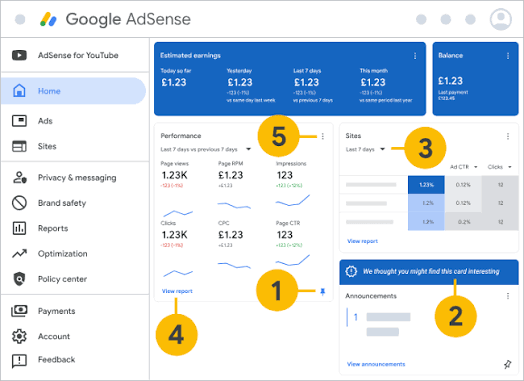
Monitor Performance: Regularly review your AdSense reports and analytics to identify which content, keywords, and ad formats drive the most revenue.
Stay Updated: The digital landscape evolves rapidly. Stay informed about platform updates, policy changes, and new features to stay ahead of the curve.
Earning money online with Google AdSense in 2026 is not about luck—it's about strategy. By combining a solid foundation of helpful, high-quality content that meets Google's strict E-E-A-T standards with smart optimization of new features like Offerwall, dynamic ads, and high-CPC keyword targeting, you can build a legitimate and sustainable income stream .
While the journey requires effort and patience, the tools are more sophisticated and accessible than ever. Rejection is not final, and with the right approach, you can join the ranks of publishers successfully monetizing their digital content.