Beginner's Guide to Investing in Kenya: Your 2026 Roadmap to Financial Freedom
The question echoes across countless WhatsApp groups, family gatherings, and office lunch breaks: "Where should I put my money to make it grow?" For many Kenyans, the world of investing feels like an exclusive club reserved for the wealthy, a realm of complex jargon and risky bets. The fear of losing hard-earned money, coupled with memories of collapsed chamas and pyramid schemes, often holds people back .
Yet, the truth is far more empowering. Investing isn't just for the financially savvy elite. It's a journey that anyone can begin with the right mindset, a little knowledge, and, most importantly, consistency. Whether you have a few thousand shillings from a side hustle or a lump sum from a bonus, the digital and regulatory landscape in Kenya has evolved to make investing more accessible than ever before .
This guide is your comprehensive roadmap to navigating the Kenyan investment landscape in 2026. We'll demystify the jargon, break down the options, and give you a practical, step-by-step plan to start building your wealth today.
Understanding the 2026 Investment Landscape
Before diving into specific investments, it's crucial to understand the economic environment shaping your decisions. As we move through 2026, two key trends stand out.
First, money is becoming cheaper. The Central Bank of Kenya (CBK) cut its benchmark lending rate to 9.0% in December 2025, a move designed to stimulate borrowing and economic activity . This means that the cost of loans is decreasing, which is positive for businesses and individuals looking to finance projects. However, it also means that traditional savings accounts are offering even lower returns.
Second, while inflation has cooled to around 4.5% as of late 2025, the cost of living remains high for many . This "pressure economy" means your money needs to work for you just to maintain its purchasing power, let alone grow. The high inflation of the past few years has pushed investors toward higher-yielding investments to outpace the rising cost of goods and services . This is where wise investing becomes not just a path to wealth, but a necessity for financial survival.
The good news is that the Kenyan investment industry is booming. The Capital Markets Authority (CMA) has reported a surge in retail investors, with the number of individuals investing in unit trusts more than doubling from about 1.29 million to nearly 2.96 million in just one year . This has driven total assets under management in collective investment schemes to a staggering KSh 851.71 billion as of the first quarter of 2026 .
This growth is attracting new players. New fund managers, investment advisors, and digital platforms are being licensed, providing more choice and competition for your shilling . The options have never been so plentiful or so accessible.
Step 1: Preparing Your Financial Foundation
Investing without preparation is like building a house on sand. Before you put a single shilling into the market, you need to lay a solid financial groundwork.
The Investor's Self-Assessment: Know Thyself
The first question to ask is: What is your risk appetite? This isn't about how much money you have, but about how you would react to the ups and downs of the market. To figure this out, ask yourself a few key questions :
When do I need this money? Is this for a holiday next year (short-term), a down payment for a house in five years (medium-term), or your retirement in 30 years (long-term)?
How fast can I get it out? Do you need the investment to be highly liquid (easily accessible) or can you afford to lock it away for a while?
Can I afford to lose this money? If the investment dropped by 20% tomorrow, would you panic and sell, or would you see it as a buying opportunity?
A simple rule of thumb is that risk generally increases with the complexity and potential return of an investment. Financial experts often describe a "risk ladder" :
Lowest Risk: Money Market Funds (cash-like, stable).
Low-Moderate Risk: Fixed Income Funds (government and corporate bonds).
Moderate Risk: Balanced Funds (a mix of bonds and stocks).
High Risk: Equity Funds (company stocks).
Highest Risk: Specialized investments like cryptocurrencies or private equity.
Build a Safety Net First
Before you even think about stock market returns, build an emergency fund. This is a cash reserve that can cover at least three times your monthly budget . This fund is your financial shock absorber, protecting you from having to sell your investments at a loss in case of a job loss, medical emergency, or unexpected expense. A Money Market Fund (MMF) is an excellent place to park this emergency fund because it offers safety and high liquidity, allowing you to access your money quickly .
The Power of Consistency, Not Amount
One of the most persistent myths is that you need a lot of money to start investing. This is false. The most important ingredient isn't the size of your initial investment, but consistency . Time, not timing, builds wealth .
Start Small: Many unit trusts in Kenya allow you to start with as little as KSh 1,000 .
Automate Your Savings: Set up a standing order to send a fixed amount, even KSh 1,000 or KSh 5,000, to your chosen investment fund at the beginning of each month . This "pay yourself first" strategy ensures you're consistently contributing before you have a chance to spend the money on non-essentials.
The math is simple: KSh 100 per day = KSh 36,500 per year . That seemingly insignificant amount can form the foundation of a substantial investment portfolio over time, especially when compounded.
Step 2: The Main Investment Options in Kenya
Now that you have the basics down, let's explore the primary investment vehicles available to you. Think of these as the ingredients for your wealth-building meal .
A. Government Securities: The Safest Bet
For those who prioritize safety above all else, government securities are the gold standard. You are lending your money to the government, which pays you interest over a fixed period. The risk of default is incredibly low.
Treasury Bills (T-Bills): These are short-term instruments that mature in 91, 182, or 364 days . They are highly liquid and a great option for parking cash for a few months. The minimum investment is KSh 50,000 for non-competitive bids . Recent auction rates have been attractive, with the 91-day paper seeing massive demand and yields climbing to around 8.7% .
Treasury Bonds: These are long-term loans to the government, usually for more than a year, often used to fund major infrastructure projects like roads or energy . They typically offer higher interest rates than T-Bills in exchange for the longer commitment. You can access these digitally through the DhowCSD app, which has made investing in government paper much simpler .
B. Unit Trusts: The "Cooked Meal" for Beginners
If analyzing stocks and bonds feels overwhelming, a unit trust is your "cooked meal." A professional fund manager pools money from thousands of investors and invests it on your behalf . This provides instant diversification and expert management.
Money Market Funds (MMFs): These invest in short-term, low-risk instruments like T-Bills and fixed deposits. They are very safe, highly liquid, and offer returns that are typically higher than a savings account. They are ideal for your emergency fund or short-term goals (1–3 years) . However, they rarely beat inflation in the long run and are not suitable for wealth-building goals like retirement .
Fixed Income Funds: These invest in longer-term bonds. They offer more stability and better returns than MMFs over the medium term (3–7 years) . They are a good option for goals like saving for a house down payment.
Equity Funds: These funds invest primarily in stocks on the Nairobi Securities Exchange (NSE). They carry higher risk because the stock market can be volatile, but they offer the potential for high growth and are essential for long-term goals like retirement .
Balanced Funds: These provide a diversified mix of both bonds and stocks, offering a middle ground between risk and return .
The industry is booming. In Q1 2026, the top two unit trusts (Sanlam and Standard Investment Trust) each crossed the KSh 130 billion mark in assets under management, driven by a surge in investor confidence . You can start with as little as KSh 1,000 with many providers .
C. Stocks & Equities: Owning a Piece of a Company
When you buy a share of a company listed on the Nairobi Securities Exchange (NSE), you become a part-owner. Your returns come from two sources: capital appreciation (the share price going up) and dividends (a share of the company's profits) .
In 2026, the NSE has shown signs of resilience. While there have been weekly dips, the NSE 20 index was up over 12% year-to-date in June 2026, driven by positive performances from large-cap companies in the banking and consumer goods sectors .
How to Start: You don't need to be a millionaire. Innovations like Ziidi M Trader are integrated with M-Pesa, allowing you to buy shares starting from as little as one unit, dramatically lowering the entry barrier .
The Strategy: For most beginners, picking individual stocks is a gamble. A safer, more effective approach is to invest in an Equity Unit Trust Fund, which spreads your risk across many companies . This diversification protects you from the failure of any single company.
D. Real Estate: The Tangible Asset
Land and property have long been favored investments in Kenya. They are tangible assets that generally appreciate over time . However, there are significant drawbacks.
Liquidity Risk: Real estate is illiquid. You can't easily sell land or a house when you need cash quickly.
Hidden Costs: Buying and selling property comes with high transaction costs, including legal fees, stamp duty, and valuation fees.
Fraud Risk: The land sector in Kenya is notorious for fraud, making due diligence essential.
Alternatives for Exposure:
Real Estate Investment Trusts (REITs): These allow you to invest in property portfolios without the headache of being a landlord. You can buy units in a REIT that owns and manages commercial or residential properties, earning a share of the income. Examples include the Acorn D-REIT and I-REIT . However, the minimum investment for a Development REIT can be as high as KSh 5 million, making it inaccessible for most .
Rental Properties: If you have the capital and are willing to manage the property, rental income can provide a steady, passive income stream .
E. SACCOs: The Community Pillar
Savings and Credit Cooperative Organizations (SACCOs) are a popular and trusted way to save and invest in Kenya. They offer a unique combination of savings, access to affordable loans, and dividends. While they are regulated, the returns are often more predictable and less volatile than the stock market. They are an excellent option for disciplined savers looking to build capital for a specific goal, like a car or a home .
F. Emerging Options: What About Crypto?
Digital assets like cryptocurrencies are becoming a topic of interest. Experts, however, generally view them as highly speculative .
The View: Financial advisors caution that they are "mostly 'invest and wait' platforms" and should not be the backbone of one's portfolio .
The Role: They can play a minor role in diversification, but for a beginner, they are far riskier than established asset classes. Avoid the temptation of "guaranteed returns" that often mask pyramid schemes or unlicensed forex entities .
Step 3: The Practical Guide to Getting Started
You've read the theory. Now, let's get practical.
How to Choose a Fund or Broker
Check Licensing: Only deal with institutions licensed by the Capital Markets Authority (CMA) or the Central Bank of Kenya (CBK) . Legitimate firms provide clear fact sheets and transparent returns. You can check the CMA website for a list of licensed fund managers and investment advisors .
Read the Fact Sheet: Before investing in any unit trust, review its Fact Sheet. Look for :
Asset Allocation: What is the fund invested in?
Top 10 Holdings: Which specific companies or assets make up the bulk of the fund?
Performance vs. Benchmark: Is the fund performing better or worse than its market index?
Check the Fees: Fees matter. A 1% difference in annual fees can reduce your total returns by nearly 30% over 20 years . Always ask about management fees, entry fees, and exit fees.
Where to Go or Who to Talk To
Your Bank: Visit any major bank branch and ask for the investment desk. They can guide you toward their wealth management products .
Digital Platforms: You can start online. Most fund managers have downloadable application forms or digital sign-up options. The CMA has recently licensed fintech intermediaries like Chumz (Moneto Ventures) and Pesa Bridge to provide a mobile-first digital infrastructure that bridges retail investors with licensed fund managers, making it even easier to start .
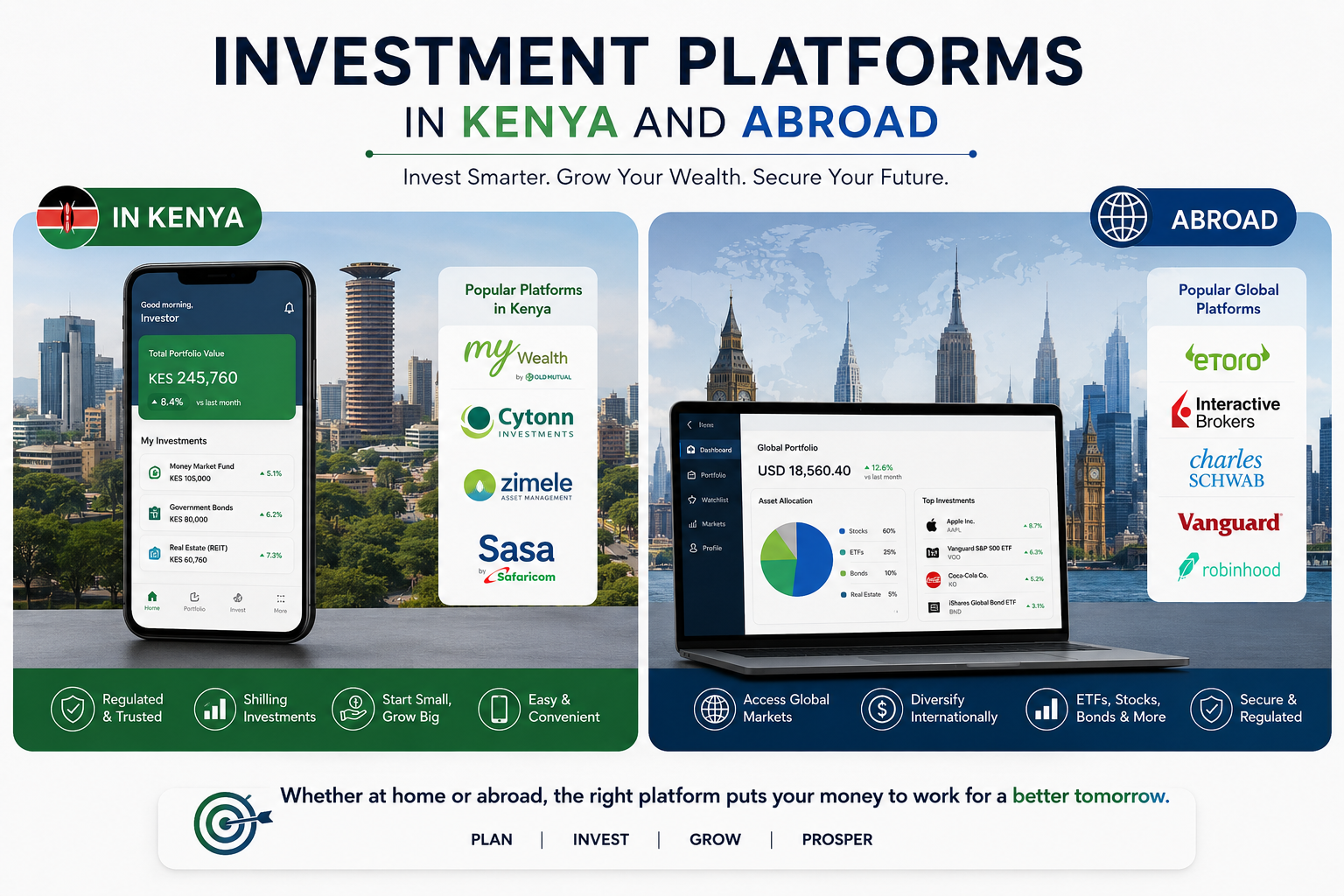
Online Brokers (for International Exposure): If you're interested in investing in global markets, international brokers like Interactive Brokers and MEXEM are available in Kenya. They offer access to a wide range of products and low fees, making them ideal for a dollar-cost averaging strategy .
Step 4: Advanced Strategies and Avoiding Pitfalls
Diversification: The Matatu Principle
"Don't put all your eggs in one basket." Like taking a matatu—if one breaks down, you can hop on another. If one investment underperforms, others keep you moving toward your goal .
A simple diversification strategy for a beginner with KSh 10,000 could look like this :
KSh 5,000 in a Money Market Fund for safety and liquidity.
KSh 3,000 in a fixed-income or balanced unit trust for stability.
KSh 2,000 into shares of fundamentally strong companies at the NSE or an equity unit trust for growth.
The Power of Compounding and Dollar-Cost Averaging
Compounding: This is the engine of wealth. It means earning returns on your returns. The earlier you start, the more powerful this effect becomes .
Dollar-Cost Averaging (DCA): This involves investing a fixed amount of money at regular intervals, regardless of the market's performance. When prices are low, you buy more shares; when they are high, you buy fewer. This removes the pressure of trying to "time" the market and helps smooth out the average price you pay over time . Platforms like Interactive Brokers allow you to automate this strategy, a perfect approach for the busy professional .
Common Pitfalls to Avoid
Following the Crowd: Don't invest in something just because it's trending in a WhatsApp group. Do your own due diligence.
Confusing Saving with Investing: Saving is for short-term goals. Investing is for making your money grow to beat inflation over the long term .
Falling for "Guaranteed High Returns": If it sounds too good to be true, it probably is. Stay away from "fast-money traps" .
Not Reviewing Your Portfolio: Your life goals and the economy change. Review and rebalance your portfolio whenever there is a major change in your life, income, or market conditions .
Final Word: Start Today
The best time to start investing was yesterday. The second best time is today. The fear of entering the market is normal, but staying out of the market entirely is often riskier than entering it thoughtfully .
You don't need to be an expert. You just need to be disciplined. Start with clarity, invest money you don't need immediately, choose products you understand, and focus on consistency and patience.
Your financial freedom isn't built on a single lucky bet. It's built quietly, almost invisibly, through steady, consistent, and informed decisions. Your future self will thank you for the step you take today.