Financing the Future: A Comprehensive Guide to Scholarships and Education Loans for Kenyan Students
The pursuit of higher education in Kenya has long been recognized as a powerful engine for personal advancement and national development. However, for countless families across the nation, the dream of a university degree or technical training has been shadowed by the daunting reality of cost. As the 2026 academic year approaches, the path to tertiary education is being reshaped by a new funding paradigm that blends direct government scholarships with affordable loans and a wealth of international opportunities. This guide cuts through the complexity, offering a detailed roadmap to the scholarships and education loans available to Kenyan students, enabling you to navigate the financial landscape with confidence and secure the resources to turn your academic ambitions into reality.
The New Frontier of Higher Education Financing in Kenya
Kenya's approach to funding higher education has undergone a significant transformation, moving away from a system of block grants to universities toward a student-centered approach. Under the Student-Centred Funding Model, resources are distributed directly to students based on their demonstrated financial need . This model is designed to be more equitable, ensuring that the most vulnerable students receive the highest level of government support.
At its core, the system operates through two primary channels: the Universities Fund for scholarships and the Higher Education Loans Board (HELB) for loans. To access these government resources, the journey is a structured, multi-step process. First, students must secure a placement in a public university through the Kenya Universities and Colleges Central Placement Service (KUCCPS) . The model distinguishes between public and private institutions: students placed in public universities are eligible for both scholarships and loans, while those in private universities can access only loans . The remaining balance of tuition and fees is expected to be covered through household contributions, creating a partnership between the government, the student, and their family.
The application for all government funding is centralized through the Higher Education Financing (HEF) portal, a crucial gateway for any student seeking financial support. This is where the Means Testing Instrument (MTI) is applied, a scientific tool used by HELB to assess an applicant's level of financial need [citation:9, 10].
The Means Testing Instrument (MTI)
Understanding the MTI is fundamental to understanding your potential funding package. It is not simply based on a student's KCSE grade but is a holistic assessment of a household's socioeconomic status. The MTI analyzes a range of proxy indicators to place a student into one of several categories: vulnerable, extremely needy, needy, or less needy [citation:9, 10]. Key factors considered include:
Family Structure: Whether the student is an orphan (total orphans receive the highest support) .
Parental Employment and Income: The official employment and financial status of parents or guardians .
Schooling History: The type of primary and secondary school attended and the fees paid, which act as indicators of family income .
Sibling and Household Information: The number of siblings in the household and other dependents .
Disability and Marginalization: Whether the student or their family faces specific vulnerabilities [citation:9, 10].
A student's classification under the MTI directly determines the proportion of their funding that comes as a non-repayable scholarship versus a loan. Students from low-income households receive more grants and fewer loans, while those from higher-income families receive fewer grants and are expected to take on more loans . In the 2023/24 academic year, nearly half (48%) of government funding for tertiary education was issued as grants, highlighting the significant investment in equity .
Government Scholarships and Loans: A Symbiotic System
The new funding model unites the scholarship and loan arms of the government into a single, coherent application process. To be considered for any government funding, a student must apply through the HEF portal.
Universities Fund Scholarships
The Universities Fund (UF) is the government agency responsible for providing scholarships to eligible students. These scholarships are a critical component of the Student-Centred Funding Model, as they represent the "equity pillar" of the system, providing support that does not have to be repaid .
To qualify for a UF scholarship, a student must have attained a minimum mean grade of C+ in their KCSE and be placed in a public university through KUCCPS . The scholarships range from 30 to 70 percent of the tuition costs, with the exact percentage determined by the MTI [citation:11, 12]. The remaining tuition balance is then covered by a HELB loan and household contributions. The government has capped tuition fee support at a minimum of KSh 5,900 and a maximum of KSh 75,000 per semester under the model .
The UF has been making significant disbursements, with KSh 31.1 billion allocated for scholarships in the 2026/2027 financial year . In the 2024/25 fiscal year, the Fund released KSh 16.9 billion to public universities to cover tuition for 257,523 students . This demonstrates the government's substantial commitment to making university education accessible. Application cycles occur regularly, with first-year students applying after KUCCPS placement and continuing students required to reapply annually .
Higher Education Loans Board (HELB)
HELB is the cornerstone of Kenya's student financing framework, providing low-interest loans to students in both public and private universities. Its role in the new funding model is to complement the scholarship, helping cover the tuition balance and providing upkeep loans for living expenses.
HELB Undergraduate and TVET Loans
The standard HELB Undergraduate Student Loan is the primary financial aid instrument for university students, and it comes at an exceptionally low interest rate of 4% per annum [citation:5, 13]. This interest rate is only applied after a student has completed their studies and entered the repayment period, which begins one year after graduation . The loan amount generally ranges from KSh 40,000 to KSh 60,000 per year, but the exact figure depends on the student's assessed need and placement category . A portion of the loan is often paid directly to the university for tuition, with the remainder disbursed to the student's account for upkeep .
For students pursuing technical and vocational education, HELB TVET Loans are available at an even lower interest rate of 4% per annum, with maximum amounts typically around KSh 50,000. These government-subsidized loans are a vital tool for supporting Kenya's skills development agenda . A significant policy shift in June 2026 has extended HELB eligibility to Kenya Medical Training College (KMTC) students, following a directive from President William Ruto . This expansion ensures that thousands of medical students who were previously excluded can now access the same government-sponsored loans as their counterparts in universities and TVETs . Applications for KMTC students are expected to open once HELB releases the specific funding framework .
HELB Jielimishe Loan
Recognizing that learning does not end with a university degree, HELB offers the Jielimishe Loan for working professionals and self-sponsored students who wish to pursue further education. This loan caters to professional courses and self-development education, offering up to KSh 500,000 at a 10% per annum interest rate. It is an excellent resource for lifelong learning and career advancement .
HELB First-Time vs. Subsequent Applications
Navigating the HELB application process requires attention to detail. The application process for HELB and other government funding is typically managed through the HEF portal. First-time applicants need to create an account, complete their profile with personal, education, and family details, and upload required documents such as their National ID, KCPE and KCSE index numbers, a passport photo, and the ID and phone numbers of two guarantors . They must also complete a brief financial literacy guide as part of the application . For continuing students, HELB typically opens a "subsequent" application window, as seen in June 2026, often via USSD code *642# [citation:7, 12]. It is crucial to adhere to the announced deadlines to ensure continued funding.
Complementary Government Funding: The NG-CDF Bursary
Beyond the national HELB and UF programs, the National Government Constituency Development Fund (NG-CDF) remains a vital source of financial support for students in every constituency. This localized fund provides bursaries to students in secondary schools and tertiary institutions . The allocation and disbursement of NG-CDF bursaries are managed by the local Member of Parliament, who selects beneficiaries through a vetting process .
In one notable example, Teso North MP launched a KSh 79 million bursary fund in 2026, with KSh 40 million allocated to secondary schools and the remainder supporting tertiary students . These funds often provide crucial support for students to cover school fees and related expenses. Students are advised to inquire about NG-CDF bursary application windows and criteria at their constituency office.
Private Sector and Bank Loans: Filling the Financial Gap
Even with government support, there can be a significant financial gap, particularly for students in private universities or those with high costs of living. This is where commercial banks and other financial institutions step in, offering education loans to bridge the difference.
Kenya Commercial Bank (KCB) Masomo Loan
KCB offers the KCB Masomo Education Loan, a school fees financing option for all levels of education, from primary school to university. With a loan limit of up to KSh 3,000,000 and an interest rate of 13% per annum, it is one of the larger private options available. Its approval time is typically 24-48 hours, making it a viable option for urgent needs .
Equity Bank Elimu Loan
Equity Bank's Elimu School Fees Loan is a similar product, offering up to KSh 2,000,000 at a 14% per annum interest rate. Designed to finance school fees at all levels, its approval process is also relatively quick, taking 24-48 hours . Equity Bank is also well-known for its "Wings to Fly" scholarship programme, a significant secondary school scholarship initiative that provides a pathway for bright but needy students .
Co-operative Bank School Fees Advance
The Co-op School Fees Advance from Co-operative Bank provides a maximum amount of KSh 2,500,000 with a 14% per annum interest rate. This product is available to its customers, covering all education levels .
Study Abroad Loans
For students with dreams of pursuing an international education, financing can be a significant hurdle. While HELB does not cover international studies, private Kenyan banks and international fintech platforms are stepping in [citation:2, 6].
Kenyan Banks like Equity, KCB, and Bank of Baroda offer education loans for foreign institutions. However, these often require collateral (usually property), have funding caps that may not cover total costs, and can take 3-6 months to process, making them less ideal for tight admissions deadlines .
International student loan platforms, such as GlobCred and MPOWER Financing, offer a new alternative. These platforms use "forward-looking" underwriting, evaluating factors like the global ranking of the university and the student's future earning potential rather than collateral or a co-signer . GlobCred connects Kenyan students with over 60 international lenders through a single application, offering decisions in days and funding up to $100,000 . This model can be a game-changer for students who have secured admission to top universities but lack the traditional collateral required by local banks .
A World of Opportunity: International Scholarships for Kenyan Students
Kenyan students are highly sought after by institutions and governments around the world, offering a plethora of fully and partially funded scholarships to study abroad.
Government-Sponsored International Scholarships
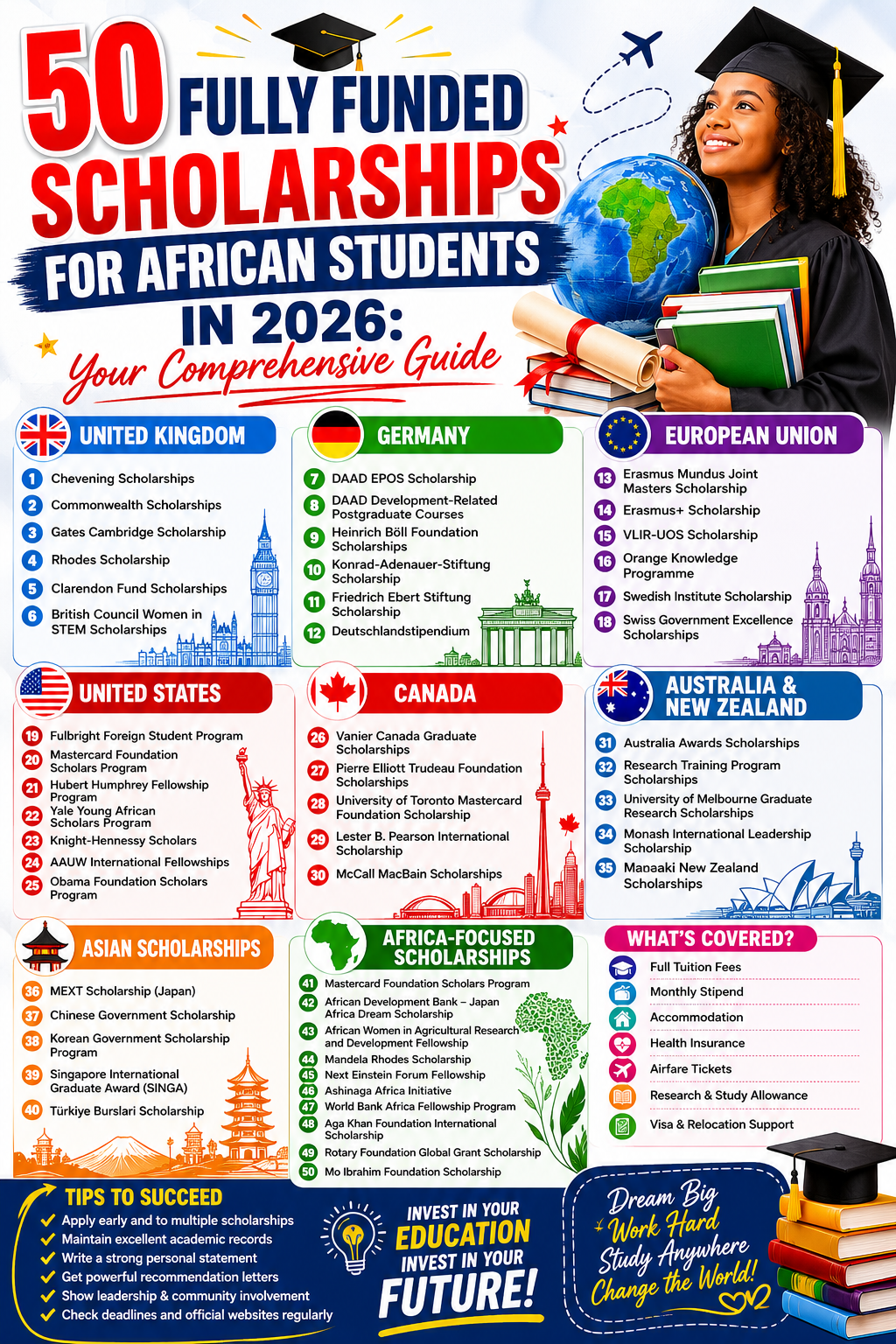
Germany (DAAD Scholarships): The German Academic Exchange Service (DAAD) offers several prestigious programs for Kenyans. The Helmut-Schmidt Programme provides fully funded master's scholarships with a monthly stipend of approximately KSh 147,000 . The DAAD EPOS (Development-Related Postgraduate Programs) also targets students and professionals from developing countries like Kenya, offering a monthly stipend of approximately €850-€992, travel allowances, and health insurance .
Japan (MEXT Scholarship): The Japanese Government, through the Ministry of Education, Culture, Sports, Science and Technology (MEXT), offers fully funded scholarships for undergraduate students. This highly competitive scholarship covers a five-year term (including a year of Japanese language training) and requires a minimum of KCSE Mean Grade A Plain . The application window for the 2027 cohort opens in April 2026 .
Ireland (GOI-IES): The Government of Ireland International Education Scholarship programme offers fully funded scholarships for master's, postgraduate diplomas, and PhD studies, providing a monthly stipend of approximately KSh 128,000 .
United Kingdom (Chevening): The UK government's flagship Chevening Scholarship program offers fully paid scholarships with a monthly stipend to Kenyans for one-year master's programs in the UK .
Netherlands: The Netherlands offers full scholarships for master's degrees in specialized fields like Geo-Information Science (GIS) and Earth Observation .
Morocco, China, and Hungary: These countries have consistently offered scholarships to Kenyan students. Hungary and China offered Kenyans 218 scholarship slots in a recent announcement .
International Scholarships and Fellowships
Beyond national governments, numerous international organizations and foundations offer scholarships:
ScottishPower Scholarship: The UK-based energy company offers fully funded scholarships for international students, including Kenyans, with a generous monthly stipend .
EPFL Master Excellence Fellowships: The Swiss Federal Institute of Technology Lausanne offers fellowships with up to CHF 10,000 in funding for master's students .
United Nations Graduate Study Programme: The UN Office at Geneva offers a two-week study programme for graduate students .
UNESCO-Aschberg Programme: Provides up to $50,000 in funding for artists and cultural professionals .
These programs demonstrate that Kenyan students have a remarkable range of options to fund their education globally.
Conclusion: Building a Brighter Future
The path to higher education in Kenya is more navigable than ever before. The Kenyan government, through the Student-Centred Funding Model, the Universities Fund, and HELB, has created a framework that prioritizes equity and access. By leveraging the Means Testing Instrument, the system ensures that those with the greatest need receive the most substantial support in the form of scholarships and affordable loans. For students in TVET institutions and now, for the first time, KMTC students, the doors to government funding are open .
Yet, the landscape is not solely dependent on government resources. The rise of private education loans from major banks like KCB and Equity offers families and individuals a crucial supplement to cover fees at all levels of education. For those with international aspirations, specialized study abroad loan platforms like GlobCred are breaking down traditional barriers, while a wealth of international scholarships from governments and institutions worldwide stand ready to welcome talented Kenyans.
Ultimately, the key to unlocking this world of financial support lies in proactive research, timely application, and a thorough understanding of the available options. Whether it's logging into the HEF portal for a HELB loan, applying for a Constituency Bursary, or writing an application for a DAAD or Japanese Government scholarship, the first step is the most important one. The resources are there; the opportunity is real. The future of Kenya's youth is bright, and with the right financial tools, they can build it.