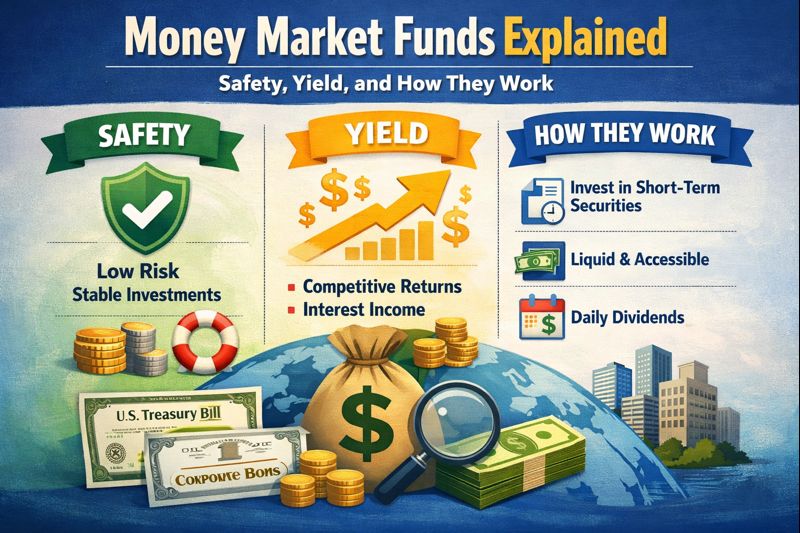
What is a money market fund? Learn how they work, their pros and cons, yields, risks, and how to use them in your portfolio. Your guide to safe, liquid cash management.
In a world of volatile stocks and rocky bond markets, investors often seek a stable, accessible place to park their cash. Enter the money market fund. A cornerstone of conservative investing and corporate treasury management, these funds offer a unique blend of liquidity, safety, and yield. But what exactly are they, and how do they work? This comprehensive guide breaks down everything you need to know about money market funds.
What is a Money Market Fund?
A money market fund is a type of mutual fund designed to offer investors high liquidity with a very low level of risk. It invests in short-term, high-quality debt securities, often referred to as "cash equivalents." The primary goal is not aggressive growth, but rather the preservation of capital while providing a modest income stream.
Think of it as a step above a traditional savings account but with different mechanics and potentially better returns. Unlike a bank account, a money market fund is an investment security, not a deposit.
How Do Money Market Funds Work?
Fund managers pool money from thousands of investors to buy a diversified portfolio of short-term instruments. These typically include:
Treasury Bills: Short-term U.S. government debt.
Commercial Paper: Unsecured, short-term loans to large, creditworthy corporations.
Certificates of Deposit (CDs): Bank-issued time deposits.
Repurchase Agreements (Repos): Short-term, collateralized loans, often between banks.
Government Agency Debt: Short-term securities from entities like Fannie Mae.
By maintaining a very short average portfolio maturity (legally required to be 60 days or less for most funds), these funds minimize sensitivity to interest rate changes and aim to maintain a stable net asset value (NAV).
The Key Feature: Stable NAV and the $1 Benchmark
Most money market funds aim to maintain a constant share price of $1.00. This "stable NAV" is a psychological and operational cornerstone, reinforcing the idea of safety and capital preservation. Income generated by the fund's holdings is distributed to shareholders as dividends, which can be reinvested or paid out as cash.
It’s crucial to understand that this $1 price is not guaranteed. While extremely rare, it is possible for a fund to "break the buck," meaning its NAV falls below $1 due to losses in the underlying portfolio.
Money Market Fund vs. Money Market Account: What's the Difference?
This is a common point of confusion.
Money Market Fund: An investment product offered by brokerage firms and mutual fund companies (e.g., Vanguard, Fidelity). It is not FDIC-insured.
Money Market Account (MMA): A type of interest-bearing savings account offered by banks and credit unions. It is FDIC-insured up to $250,000 per depositor.
The choice often comes down to seeking potentially higher yields (fund) versus absolute principal protection (bank account).
Advantages of Money Market Funds
High Liquidity: Shares can typically be bought or sold at any time, with settlements often happening in one business day. Many funds offer check-writing or electronic transfer privileges.
Low Volatility: The short-term nature of the investments shields them from the dramatic price swings seen in stocks and bonds.
Better Yield Than Traditional Savings: While returns fluctuate with interest rates, money market fund yields often compete with or exceed those of high-yield savings accounts, especially in rising rate environments.
Capital Preservation: The primary objective is to protect your initial investment.
Diversification: A single share gives you exposure to a wide array of high-quality, short-term debt.
Risks and Considerations
No FDIC Insurance: This is the most critical distinction from bank products. While the risk of loss is low, it is not zero, as seen during the 2008 financial crisis.
Inflation Risk: In periods of high inflation, the fund's return may not keep pace with rising prices, eroding your purchasing power over time.
Low Returns: They are not growth investments. The trade-off for safety is lower long-term return potential compared to stocks or bonds.
Fees: Expense ratios can eat into your yield, especially in a low-interest-rate environment. Always look for low-cost funds.
Interest Rate Risk: While minimal, funds can be affected by rapid changes in interest rates, which impact the yield on new securities they purchase.
Who Should Use a Money Market Fund?
They are an excellent tool for:
Emergency Funds: Storing 3-6 months of expenses in a liquid, low-risk vehicle.
Cash Holding "Sweep" Accounts: Many brokerages automatically place uninvested cash into a money market fund.
Short-Term Savings Goals: Saving for a down payment, large purchase, or known expense within 1-3 years.
Conservative Investors: Those who prioritize principal protection above all.
Tactical Cash: Investors waiting for a better opportunity in the stock or bond market.
How to Invest and What to Look For
You can purchase money market funds directly through mutual fund companies or brokerage platforms. When choosing a fund, consider:
Expense Ratio: Lower costs mean more of the yield goes to you.
7-Day SEC Yield: This standardized measure shows the fund's annualized yield based on the past seven days, giving you a truer picture of current income than a simple dividend rate.
Minimum Investment: Some funds require an initial investment of $1,000, $3,000, or more.
Fund Type: Prime (corporates), Government (U.S. Treasuries & agencies), or Tax-Exempt (for high-tax-bracket investors).
The Bottom Line
Money market funds are a vital component of a well-rounded financial plan, acting as a safe harbor for cash that needs to be both accessible and productive. They are not a path to wealth creation, but rather a sophisticated tool for capital preservation and liquidity management.
Before investing, align the product with your goal. For absolute safety of principal, an FDIC-insured bank account may be preferable. For optimizing yield on cash you don't need immediately, while accepting a microscopic level of risk, a low-cost money market fund from a reputable institution is a powerful choice. In today's economic landscape, understanding this distinction is key to making informed, confident decisions with your cash.